
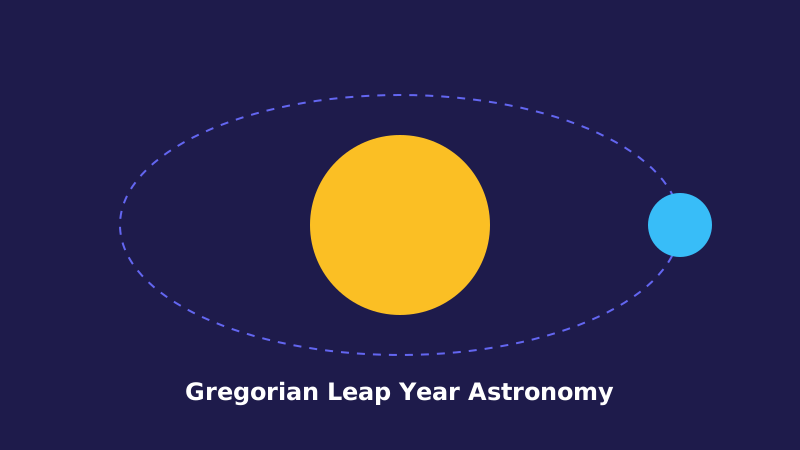
The Solar Year vs. The Human Calendar
Most people learn in primary school that a leap year occurs every four years by adding February 29. While this simple rule works for day-to-day life, it is incomplete. If we strictly added a leap day every four years without exception, our calendar would drift out of sync with the solar equinoxes by approximately 3 days every 400 years.
To understand why, we must look at the true astronomical length of a tropical year (the time it takes Earth to complete one orbit around the Sun from equinox to equinox):
1 Mean Tropical Year ≈ 365.24219 Days (365 days, 5 hours, 48 minutes, and 45 seconds)
Notice that 0.24219 days is slightly less than 0.25 (which would be exactly one-fourth of a day). By adding a leap day every 4 years (as the ancient Julian calendar did), we were overcompensating by approximately 11 minutes and 14 seconds per year.
The Gregorian Three-Step Rule
In 1582, Pope Gregory XIII and astronomer Aloysius Lilius introduced the Gregorian reform to correct this drift. The complete Gregorian leap year rule consists of three precise criteria:
- The 4-Year Rule: Any year evenly divisible by 4 is a candidate leap year (e.g., 2024, 2028).
- The 100-Year Century Exception: If the year is also divisible by 100 (an end-of-century year), it is NOT a leap year (e.g., 1700, 1800, 1900, 2100).
- The 400-Year Century Override: If the century year is also evenly divisible by 400, it IS a leap year after all (e.g., 1600, 2000, 2400).
Century Comparison Table
| Year | Divisible by 4? | Divisible by 100? | Divisible by 400? | Leap Year Status |
|---|---|---|---|---|
| 1900 | Yes | Yes | No | Common Year (28 Days) |
| 2000 | Yes | Yes | Yes | Leap Year (29 Days) |
| 2024 | Yes | No | No | Leap Year (29 Days) |
| 2100 | Yes | Yes | No | Common Year (28 Days) |
Why 2100 Will Not Be a Leap Year
The year 2000 was a once-in-four-centuries event: a century year that was also a leap year. Because of this, most living adults have never witnessed a century year that skipped its leap day. When the year 2100 arrives, February will have only 28 days, reaffirming the 400-year cycle designed over four centuries ago.
You can verify any historical or future year using our interactive Leap Year Checker or test birthday milestones with the Age Calculator.